In May, Nobel laureate Olga Tokarczuk mentioned at a conference in Poznań that while writing her latest novel, she asked an AI model what songs her characters might have danced to at a party several decades back. It gave her a few song titles. That was the whole crime, and it turned into an AI disclosure scandal at the Nobel level.
Within days, headlines said she’d used AI to write the novel. Commentators called for her Nobel Prize to be rescinded. She had to issue a formal statement through her publisher. In it, she explained that she writes alone, has for decades, and uses AI as a tool that allows faster documenting and checking of facts. She verifies those facts anyway, the same way she’s always verified them in libraries and archives. She even felt compelled to clarify that when she’s inspired by dreams, the dreams are her own.
A Nobel Prize winner. Clarifying the provenance of her dreams. In writing.
She asked a chatbot a reference question. The internet heard ghostwriter. That gap is the AI disclosure problem, and if you make things and use modern tools, you’re standing in it right now.
One phrase, every meaning
“I use AI” has become a single charge that covers everything. Generating an entire quilt design and selling it as your own? I use AI. Asking what year a fabric line shipped so your show entry paperwork is accurate? Also I use AI. Auditioning a border color before you commit fifteen yards of fabric you cannot return? Same three words.
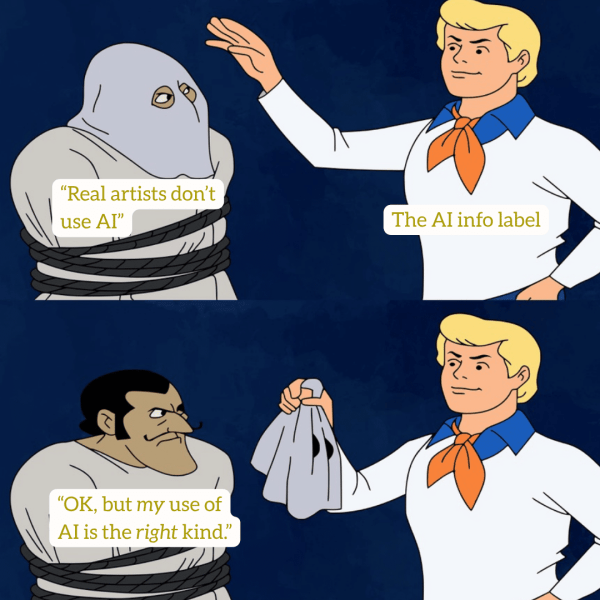
When one phrase covers the whole spectrum, admitting the small thing convicts you of the big one. So makers do the math and go quiet. And silence reads as guilt, which makes the next maker quieter, which makes the silence louder. Nobody in that spiral is lying. They just don’t have words that fit.
I have some sympathy here, and also some scar tissue. I named my business The AI Quilter, which means I volunteered for this conversation the way you volunteer to hold the ladder. I get asked whether the computer makes my quilts often enough that I’ve stopped flinching and started taking notes. (The computer does not make my quilts. It has never once threaded a needle. It would be insufferable about it if it could.)
Here’s what I’ve learned from all those conversations: the fix is not defensiveness. It’s vocabulary.
Quilting already solved this once
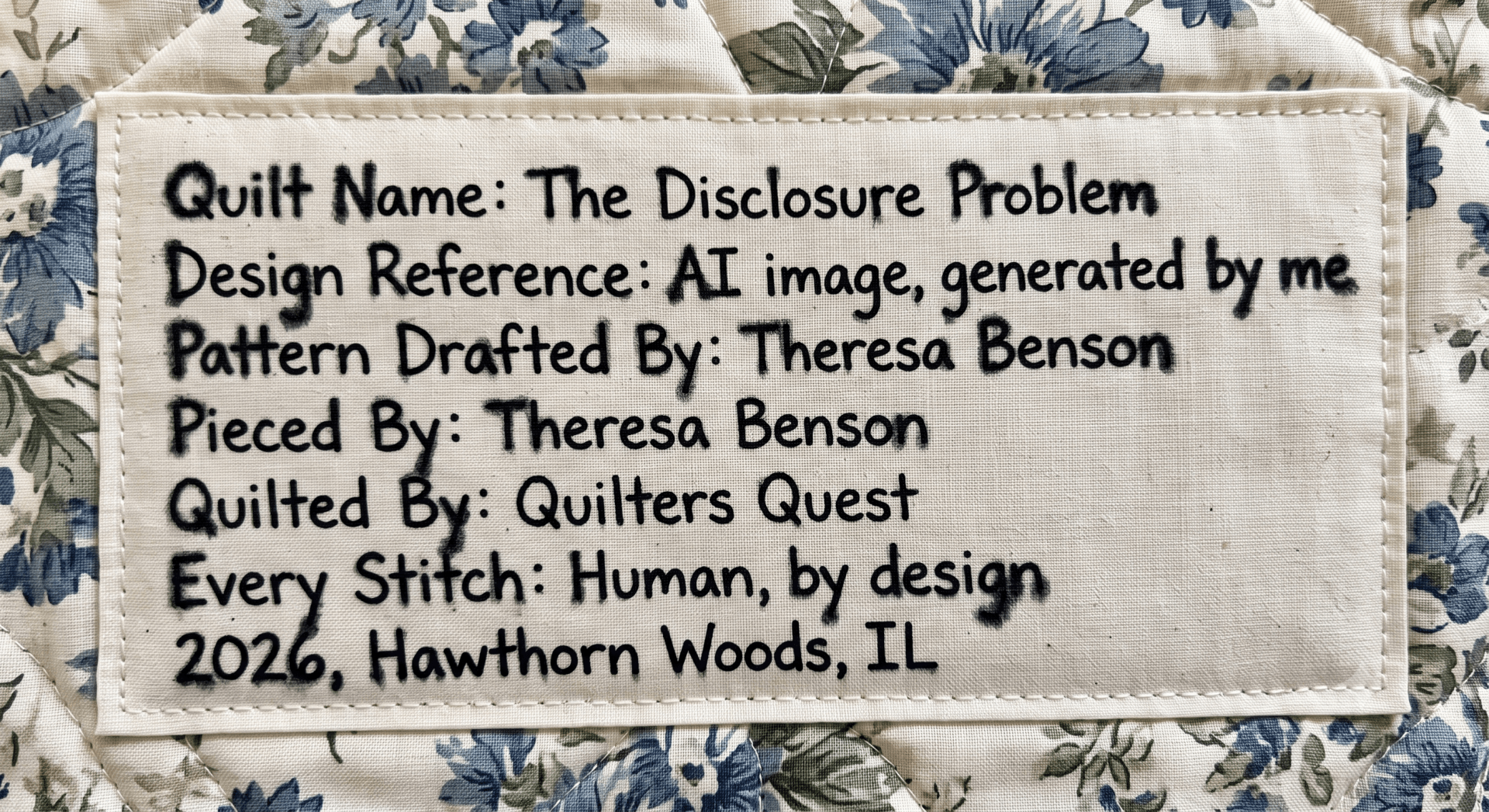
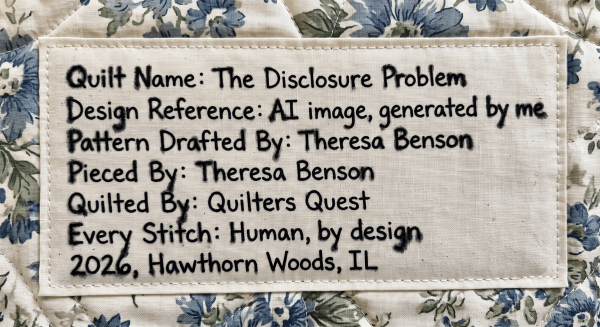
Read a quilt label at any show. “Pattern by Carolyn. Pieced by me. Quilted by Sharon on a longarm.” Three contributors, three verbs, zero scandal.
It wasn’t always that calm. Machine quilting was once treated as a moral failing, and longarm quilting after that. The argument didn’t end because one side surrendered. It ended because the community built precise language for who did what, and then built show categories around that language. Once you can say “longarm quilted by Sharon,” nobody has to whisper “machines were involved.”
We are simply overdue for the same precision about AI. Not a confession. A label.
An AI diclosure vocabulary, smallest to largest
"I used AI to look something up."
This is the reference desk. Checking when a fabric line shipped, converting yardage, finding the name of that block you can picture but can’t name. Tokarczuk’s dance songs live here. If this requires disclosure, so does owning a library card.
"I used AI to think out loud."
Brainstorming settings, auditioning colorways, asking for six variations on a layout before you pick the one that was clearly right all along. The ideas get tested; the judgment stays yours. My sentence: “I ran color options through AI before I cut anything, because my fabric budget has feelings.”
"AI made the reference. I made the quilt."
This is my lane. I generate a design image, then I draft the pattern, choose the fabrics, and make every choice one by one. The design is a starting point, the way a photograph is a starting point for a landscape quilt. My sentence: “This design started as an image I created in [platform]. Everything you can see, feel or touch, I made.”
"AI generated the finished design."
If that’s what happened, say that too, in exactly those words. Honesty runs in every direction. The maker who says this plainly is in better standing than the maker who says “I use AI” and hopes nobody asks a follow-up.
The specific sentence is the shield
Notice what precision does. A critic can do a lot with “I use AI.” They can do almost nothing with “I asked it what year a fabric line shipped.” The vague version is the weapon. AI disclosure done in exact words takes it out of the room.
And if your answer is none
Some of you read all of this and thought: my answer is that I don’t use it at all, full stop. I want to be clear that I think that’s a legitimate answer, arrived at for serious reasons, and I’m not here to talk you out of it.
But precision protects you too. A world where “I use AI” means everything is also a world where “I don’t use AI” means nothing, because nobody can tell what’s being declined. If the words are exact, your line is visible. You can’t meaningfully opt out of something nobody has defined.
The longer version of this argument
Intentional use and honest AI disclosure are the entire case I make in my book, Digital Muse: Bringing AI Into Your Creative Process. It walks through how to choose tools that match your values, how to keep your hands and your judgment at the center of the work, and how to talk about all of it without apologizing for any of it. If this post handed you a sentence you needed, the book hands you the whole language.
In the meantime: say what you did. Specifically. That’s the whole trick.
Sources: Tokarczuk’s full statement ran at Literary Hub (May 19, 2026); her original remarks at Impact’26 in PoznaÅ„ and the response were reported by Notes From Poland (May 21, 2026).
The AI Disclosure Problem: Why “I Use AI” Needs Better Words
In May, Nobel laureate Olga Tokarczuk mentioned at a conference...
Read MoreWhat I learned about AI and copyright in June
I spent time last week at the Academy for Virtual...
Read MoreStop Apologizing for Your Tools
She mentioned it almost under her breath. An instructor at...
Read MoreThe Guilt Is Aimed at the Wrong Address: AI, Data Centers, and Who’s Actually Accountable
The environmental critique of AI is real. But the pressure...
Read More