Busting the Biggest Misconceptions About AI (Especially for Quilters)
Spoiler: No, AI is not here to steal your sewing machine—or your soul. In fact, AI in quilting can be a powerful creative partner, helping quilters of all ages explore new ideas and enhance their AI-assisted creativity.
If you’re a quilter, maker, or just someone side-eyeing the whole “AI in creativity” thing, you’ve probably heard a few of these:
- “AI is going to replace artists.”
- “Using AI is cheating.”
- “It’s just a bunch of robots doing the work for you.”
Let’s bust these myths once and for all—with thread, facts, and a little bit of sass.
Misconception #1: “AI Replaces Creativity.”
This is one of biggest misconceptions. And it’s flat-out wrong.
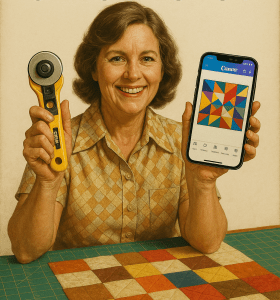
AI is a tool—not a replacement for your imagination. It doesn’t make art. You do. You’re still the creative engine behind the vision, choices, curation, and editing, you’re just doing it with words. Think of AI as the rotary cutter, not the quilt.
Yes, AI can help generate inspiration, experiment with color palettes, or expand on a prompt you input. However, it’s still your brain guiding the design.
Misconception #2: “It’s Cheating.”
Quilters don’t cheat. We innovate.
Remember machine quilting? That wasn’t cheating. Rotary cutters weren’t cheating. Printable foundation paper? Still not cheating.
Quilting with AI assistance is no different. It doesn’t devalue your art—it’s simply another way to explore creative possibilities. In fact, it can help you be even more intentional and specific with your designs.
And for those whose artistic skills once peaked at stick figures, using AI in quilting can unlock the creativity you’ve always had in your head.
Misconception #3: “All AI Art Looks the Same.”
This is only true if you treat AI like a microwave: punch in numbers, press start, and hope for dinner.
AI doesn’t magically generate brilliance—you do, by training it through prompting, editing, remixing, and iteration. Just like improvising with color or making your own patterns, AI rewards your unique perspective.
Misconception #4: “It’s All Stolen.”
It’s a significant point—and entirely valid.
The concern that some AI tools have been trained on copyrighted works without proper consent is a legitimate worry, and it should not be overlooked. Ethical use is essential, and it’s vital to identify platforms out there that follow the recommended ethicial practices and it’s even more important to know what these platforms are.
Therefore, at The AI Quilter, we only recommend platforms with transparency, ethical training practices, and respect for artists’ rights. Period.
Using AI ethically means:
✅ Choosing tools that disclose their data sources
✅ Giving credit when due
✅ Using AI to inspire, not copy
Misconception #5: “I’m Too Old/Tech-Averse to Use AI.”
Too old? Oh, honey. Guild Gertie is using Canva like a pro and running Facebook Lives from her sewing room. You’re not too old. You’re just unpracticed.
And the good news? You don’t need to become a software engineer to use AI creatively. You just need the right tools, a little guidance, and the willingness to play. You managed to learn enough technology to get to this blog, so you’re not as tech-averse as you might think.
So, if you have a vision and can write a sentence—or even a phrase—The AI Quilter is here to help.
Bottom Line?
AI isn’t scary. It’s just new. And like free motion quilting, once you learn the rhythm, you’ll wonder why you ever hesitated.
Creativity will always belong to you—quirks, imperfections, and all. AI just adds a new dimension to your toolbox once you learn how to use it to aid your creative process.
Ready to try it?
✂️ Explore our YouTube for All Things AI & Creativity
🧵 Take One of My Classes
💡 Join the Digital Muse Newsletter for More Ethical AI Tips
Let’s keep creating—with integrity, imagination, and maybe a little help from our robot friends.