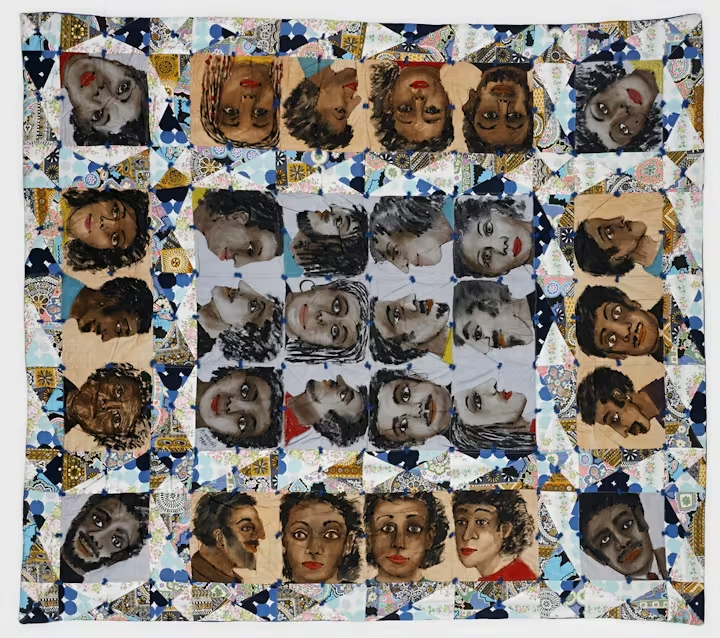
Every March, we dust off our “nevertheless, she persisted” (Thank you, Mitch McConnel for that rallying cry) mugs and celebrate the women who changed the world. We honor scientists, activists, writers, revolutionaries. And then, somewhere across town, a woman finishes a quilt so technically complex and visually stunning it would stop you cold in a gallery. We nod politely and say, “Oh, how lovely. What a fun little hobby.”
That’s the tension at the heart of quilting: the work is undeniably skilled, often staggeringly beautiful, and yet it lives in a category just slightly below “real art”. Instead it’s filed under “craft.” And that distinction, so casually made, carries centuries of bias inside it, primarily because it’s thought of as “women’s work.”
What's In A Word?
Art and craft are not opposites. Historically, they weren’t even clearly separated. Renaissance painters ran workshops that operated like trades; potters and weavers were revered. The split happened gradually, and it happened along gendered lines.
As Western art institutions formalized in the 17th and 18th centuries, they elevated painting, sculpture, and architecture into the “fine arts.” And they were domains dominated by men. Everything else: textiles, ceramics, embroidery, decorative objects — the work done primarily by women and artisans — was categorized as “applied” or “decorative” art. A lesser tier. Useful, perhaps lovely, but not serious.
The logic was circular and convenient: women’s work was craft because women did it, and women’s work was lesser because it was craft.
The Quilt as Evidence
Look at what quilters actually do and the “craft” label starts to feel absurd. A Baltimore Album quilt from the 1840s requires mastery of color theory, spatial composition, and an almost surgical precision in appliqué. The improvisational quilts made by enslaved African Americans — later recognized as a distinct aesthetic tradition — show compositional boldness that anticipates abstract expressionism by a century. Gee’s Bend quilters like Loretta Pettway and Mary Lee Bendolph create works that hang in the Whitney Museum of American Art, yet for most of their lives their genius was invisible to the art world.
Faith Ringgold provides another lens. Her story quilts — narrative textile works combining painting, fabric, and written text — explicitly challenged the boundary between fine art and craft. She was initially rejected by galleries that didn’t know what category to put her in. Today those same works are in permanent museum collections. The work didn’t change. The gatekeeping did.
Why the Label Sticks
Part of it is medium. Paint on canvas reads as “fine art” because institutions have said so for four hundred years. Thread on fabric reads as domestic, functional, humble. Even when a quilt is never put on a bed, when it exists purely as visual statement, the material carries its history with it.
Part of it is also utility. Art, in the Western tradition, is supposed to be purposeless in the highest sense: made for contemplation alone. Craft serves a function. But this distinction collapses quickly. A Rothko painting serves no function either, and yet nobody calls it craft. Meanwhile a quilt can keep you warm — but so what? A Tiffany lamp gives off light. We still call it art.
The real difference isn’t the object. It’s who made it, and in which room of the house.
Reclaiming the Frame
The good news is that this is changing. Slowly, unevenly, but genuinely. The art quilt movement has pushed textile work firmly into gallery spaces. Academics have spent decades recovering the names and works of women whose quilts were stored in attics while their husbands’ portraits hung in parlors. Museums are revisiting their own collections with fresh questions about whose work they dismissed.
This International Women’s Month, it’s worth sitting with the question of which women’s contributions we’ve unconsciously sorted into the wrong drawer. The quilts were always there. The artistry was always there. What’s shifted is our willingness to call things what they are.
A woman who can take five hundred pieces of fabric and make you feel something — she’s not a craftsperson doing a lesser thing. She’s an artist. She always was.