The One Fabric I Couldn’t Stop Seeing
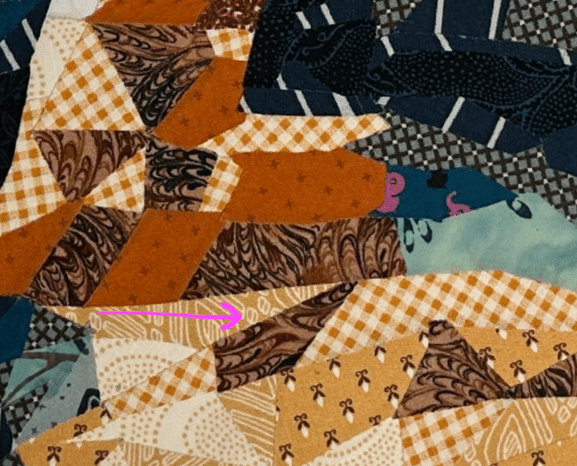
There’s one fabric in the piece I’m making right now that I cannot stop seeing. Not in a good way.
I’m building the first version of a new Commando Appliqué pattern. First versions are how I find the problems before anyone else has to, and this one found a problem fast. The fabric I picked for one section read darker in value than I expected once it was cut and placed. A quiet voice at the cutting table said, this might be too dark. I kept going.
And then I couldn’t stop seeing it.
Every Fabric Needs a Friend
There’s a collage quilter I admire, Marina Landi, who teaches that every fabric in a piece should have a friend. Never leave one fabric standing alone, because that’s the one everyone’s eye goes straight to. They stop seeing the whole quilt and start seeing the patch that doesn’t belong.
Our brains are built to find whatever stands out. The eye locks onto the outlier on its own, whether you ask it to or not. (That instinct is part of what I teach about AI, but it’s a story for another day.)
The Talking Stain
It reminded me of that Tide to Go ad from the 2008 Super Bowl, the “Talking Stain.” A guy sits down for a job interview, starts to introduce himself, and the stain on his shirt will not shut up. Nobody hears a word he says. All anyone can look at, all anyone can hear, is the stain.
That was my darker fabric. Yelling over everything else in the piece.
I Had Every Chance to Change It
Here’s the part that still gets me. I build with Lite Steam-A-Seam 2, a double-stick fusible. As long as I never touch it with an iron, nothing is permanent. I can lift a piece, swap it, nudge it half an inch, audition something else entirely.
It’s serious magic. It stays put without staying stuck.
I had every chance to pull that fabric and try again. My gut had already told me to. I pressed it down anyway, because I wanted to get to a finished thing.
When you can still change something and a real part of you says you should, pause, make the change, then check it. The pause is cheap. Reworking a pressed-down mistake is not. The whole point of a repositionable tool is the permission to stop and look again. I didn’t take it.
The Tool Doesn’t Make the Quilt
I want to sit on that for a second, because it’s the thing I say most often.
Look at how many decisions are buried in that one mistake. Which pattern to design. Which fabric to audition. How to read its value against everything around it. Whether to trust the itch in the back of my head. Where each piece sits. Whether to pause or press. How to feel about the result a month later.
Every one of those was mine. The fusible didn’t make a single one. Neither would AI, if AI were somewhere in my process. A tool inside a process doesn’t get to own the process. The choices, the taste, the gut, the pause, those stay with the maker. They stay with you. That is not a small leftover after the tools do their part.
That is the work.
What a Few Weeks Did
Two things have happened since.
It’s a few weeks later, and the piece doesn’t look anywhere near as bad as it did in the moment. Distance does that. The patch that was screaming at the cutting table is just a slightly darker fabric now, sitting in a project I’m proud of.
And the person I made the prototype for saw it and loved it. Genuinely. Could not wait to sit down and talk about it. Which confirmed what I already half knew…I was the only one in the room “hearing the stain.”
Make the New Thing Anyway
This is the first version of something new, and first versions are supposed to teach you something. Mine taught me to trust the pause next time. It also reminded me that the harshest critic of a new thing is almost always the person who made it.
Make the new thing anyway. Make it a little badly, if a little badly is what a first one is. Then go get the fresh piece of fabric when your gut tells you to.